KTIMA GEROVASSILIOU
Updated: Jul 27
NORTHERN GREECE
AN EPANOMIAN SYMPOSIUM

THE ATHENIAN SYMPOSIUM
If you are just setting off on your Greek wine journey and happen to be flying into Thessaloniki, then Ktima Gerovassiliou is probably the best place to head to first. Presuming you take my word for it, then be sure to plan in a whole day.
Here`s why.

On arrival at Ktima Gerovassiliou, it wasn't immediately apparent how vast the estate truly is. Our host, Director of International Development Konstantinos Arvanitakis, led us along a chalky white path bordered by immaculately trimmed hedgerows to arrive at what the estate calls the reception area. Also described as a café - a slight understatement - as not one corner of the premises is reminiscent of a coffee bar. In fact, I`m not sure they even serve one.
On departure we received a generous gift: two books. One titled: Malagousiá, The Cinderella of Greek winemaking grapes written by Stavroula Kourakou, the other: The Athenian Symposium and its Rituals written by Michalis Tiverios - both publications initiated by estate owner Vangelis Gerovassiliou.

The latter is an extremely interesting book and a reminder of Vangelis` personal belief in wine`s cultural importance. The book depicts the customs, symbolism and the social practices of the ancient Athenian Symposium meaning "drinking together". This ancient Greek equivalent to a Gentleman`s Social Club was governed by formal rituals and social customs, one in which women were generally excluded - unless of course, acting as entertainment. Items used in such a symposium are displayed in the Gerovassiliou Museum, which I`ll come to later.

The earliest archaeological evidence of winemaking in Northern Greece dates to 4500 BC. Even back then, decorum was high on the agenda and overindulgence associated with drunkenness and lack of discipline. According to their custom, the Greeks mixed one part wine to three parts water. They also enhanced the (already watered down) flavours, by adding honey or salt water. Today, salinity is the result of sea proximity, notes of honey - if present - the result of lengthy maturation.
Surrounded by a sea of immaculately kept vines and with the Epanomi coastline just a few kilometres away, Kostas invited us to take a seat on the outdoor terrace. A refreshing iced tea served with crispy biscuits made from grape must accompanied the initial estate introduction. A tour of the cellars and the museum followed.

THE GODFATHER OF MALAGOUSIÁ
Having completed his studies at the University of Bordeaux, Vangelis Gerovassiliou's first professional appointment was as oenologist at Domaine Porto Carras in Epanomi (1976-1999). At the time, this was one of Greece`s leading wineries with the largest single vineyard in Europe (ca. 400 ha.), also where Vangelis first encountered Malagousiá. This indigenous, early ripening Greek grape variety had virtually disappeared from the vineyard map but was being test-run - so to speak - at the Carras winery.

One of the first individuals to recognise its` aromatic qualities was Vangelis Gerovassiliou. It hence comes as no surprise, that with the revival of his own family vineyard in 1981- a mere 2,5 hectares – his first choice fell on Malagousiá. A significant decision and one which paved the way for a Malagousiá renaissance. In 1986, the first vintage was in the cellar and by 2016, the privately owned Gerovassiliou winery had expanded to over 60 hectares. Several national and international accolades followed, including Gold at the 3rd Concours International du Vin 2003 and the Decanter World Wine Awards Regional Trophy in 2013 - both of course - for the once forgotten variety.

PORTFOLIO EXPANSION
In 1998 – a year before leaving the Carras Estate - Vangelis partnered with Greek oenologist and winemaker Vassilis Tsaktsarlis. Their passionate collaboration led to further winery investment, the best known of which is Ktima Biblia Chora.

Today, the portfolio comprises five wineries, only one of which - Ktima Gerovassiliou - is solely owned by Vangelis Gerovassiliou. Each estate reflects a distinctive terroir which in turn, enables such a wide range of styles and personalities. The common thread throughout is an emphasis on indigenous Greek grape varietals, whose naturally high acidity lends both the white and red wines remarkable freshness and longevity.

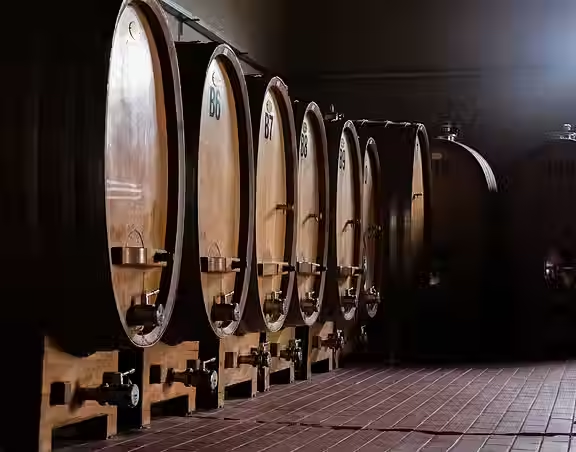
The winemaking philosophy is consistent. Extended skin contact followed by fermentation in stainless steel, maturation in French oak for selected wines, and lengthy bottle ageing before release. At Ktima Gerovassiliou they also experiment with clay amphoras. The overall result is a collection of wines with depth, elegance and proven ageing potential.
Vidiano, for example, is grown in the vineyards of Ktima Biblia Chora at high altitude on the rugged slopes of Mount Pangeon. A rare and indigenous white variety originally from Crete, which profits from the day-to-night temperature extremes. By extending the growing season, the micro-climate preserves natural acidity and enhances aroma complexity.

On the island of Therasia (opposite Santorini) Assyrtiko vines at Mikra Thira are trained using the traditional Kouloura basket system - vital for protection from strong Aegean winds and sand. Rooted in volcanic ash, pumice stone and surrounded by the sea, the vines produce crisp, acidity-driven wines - sometimes floral sometimes citrus – yet with a distinctive saline minerality for which the islands are renowned.
In the meantime Ktima Gerovassiliou works just under 120 hectares. Their flagship wine? Malagousiá! International varieties complete the portfolio including Sauvignon Blanc, Viognier, Merlot and Syrah. All groundwork is completed mechanically, vine-work and the harvest carried out by hand.

THE GEROVASSILIOU EXPERIENCE
Taking a stroll through the grounds to the wine cellar and museum, guests have the opportunity of inspecting the experimental vineyards which are dedicated to Greek varietals. One also encounters a fabulous display of Contemporary Art. Reminiscent of an outdoor vernissage, the collection includes the works of leading international and Greek sculptors; Costas Tsoclis` - A Grape Bunch, Costas Varotsos` - Moon, Horizon, Tree - aligned in perfect harmony with the level of the sea (pictured above) or Italian artist Gianni Fanello`s The Snail, who lies in wait at the entrance to the Wine Museum.

POWER CORKSCREWS & OTHER ARTIFACTS
The Gerovassiliou Museum tells a broader story of wine through archaeology and craftsmanship. A display born of a deep passion for wine and its history – also a prolific affection for collectables.
What began in the late 1970s as Vangelis` personal collection of artifacts, gradually evolved into a museum preserving centuries of viticultural heritage: from ancient amphorae to early wine analysis equipment.

The museum boasts two collections: one with a focus on viticulture, the other - a display of one of the world's largest collections of (2600) corkscrews – some of which are highly amusing and evidence of past ingenuity. The carefully composed showcase of wine's transition from the ancient world to the present day, encompasses shell-encrusted amphorae recovered from the seabed, together with 19th- and 20th-century analytical instrumentation - wine analysis before the world went digital.

I loved the Power Corkscrew adapted for ladies but that said, I hadn`t yet tried the cuisine….nor the wines.

A GODLY FLIGHT
The tasting room at Ktima Gerovassiliou is light and airy with seating both inside and out. A lively wine-lover`s hub where you`ll enjoy a professional tasting or simply a glass of wine with a snack, as much as you`ll marvel the view. Our Greek wine journey with Kostas led us from the North to the South - with a tasting unfolding in four flights.
Principally, the wines are fermented in temperature-controlled stainless-steel tanks followed by a period of contact with the lees. Exact vinification methods depend, of course, on variety and the desired result.

▪ INDIGENOUS GREEK VARIETIES

FLIGHT ONE took off with an insight into Greek varietals with wines from three of the five estates:
1. Ktima Gerovassiliou Malagousiá 2025
2. Ktima Biblia Chora Vidiano 2025
3. Ktima Biblia Chora Areti White 2023
4. Mikra Thira Santorini
5. Mikra Thira Terrasea 2023.
As to be expected, Kostas began with Gerovassiliou`s Flagship wine – a 2025 Malagousiá. The privately owned estate lies within the PGI Epanomi (Protected Geographical Indication) where regulations permit both indigenous Greek and international grape varieties. This enables Gerovassiliou to combine tradition with innovation.
The climate here is mediterranean, enjoying mild winters and hot summers with temperatures curtailed by cooling ocean winds.
In combination with sandy soils rich in clay and calcareous seabed deposits, the wines are subtly mineral with fresh acidity and an elegant structure.
▫ Ktima Gerovassiliou Malagousiá 2025 - a flamboyant character with an expressive nose of white stone fruit combined with floral honeysuckle and a hint of spice. A pale-yellow dry white, high in acidity with a zesty citrus mouthfeel.

Mikra Thira lies on Therasia, an island which (geologically speaking) once belonged to Santorini. Now separated by a narrow stretch of water, volcanic ash, pumice and lava stone form the bedrock for the vineyards. Sea breezes, although welcome, can also cause damage and the reason why vines are basket-trained (Kouloura) for protection.
The estate was established in 2017 in collaboration with oenologist Ioanna Vamvakouri. Indigenous to the island of Santorini, it comes as no surprise to find Assyrtiko thriving here with some vinestock now over eighty years of age. Of the five FLIGHT ONE wines, Terrasea 2023 was my choice of preference.
▫ Mikra Thira Terrasea 2023 – a low-yield of old Assyrtiko vines boasting colour and character: deep yellow in the glass and a herbal nose of oregano and chamomile. Vinified mainly in stainless steel, the grapes undergo slow fermentation - partially in French oak - then four months on the lees.
A complex and age-worthy wine rich in pear and peach on the palate with a full body and creamy-textured finish.

▪ ASSYRTIKO & FRIENDS
FLIGHT TWO - an example of Assyrtiko`s versatility. Four blends and three estates:
1. Ktima Dio Ipsi Dialogos White 2025
2. Ktima Gerovassiliou Estate White 2025
3. Ktima Biblia Chora Estate White 2025
4. Ktima Biblia Chora Ovilos White 2024
Ktima Biblia Chora is a joint venture founded in 1998 by Vangelis Gerovassiliou and oenologist Vassilis Tsaktsarlis. The modern winery was built in 2001, the vines planted earlier (1998) on the southern slopes of Mount Pangeon. Despite still relatively close proximity to the sea (ca. 15 km.) it’s the day and night temperature fluctuations which have the greatest impact on the vines.

Organically farmed and grown at an altitude of around 380 metres on porous rock, limestone and clay, Assyrtiko at Biblia Chora ripens much later than on the islands. Here, Assyrtiko joins forces with international varieties such as Sauvignon Blanc and Semillon. The result: a harmonious mix of the indigenous variety`s structural qualities with notes of wild herbs and exotic fruit.

Of the four wines in FLIGHT TWO I recommend Ktima Gerovassiliou`s 2025 blend of 50/50 Malagousiá and Assyrtiko: Estate White (blue label above).
▫ Ktima Gerovassiliou Estate White 2025 – just a short period of skin-contact prior to fermentation in stainless steel. Pale golden yellow with a potpourri of aromatics on the nose. The palate - a tangy lemon melody in unity with exotic melon and fragrant floral Jasmin. The finish is long with a pleasant ripeness and mellowing acidity. A great food-pairer and ready to drink.
Apropos food-pairing: I am yet to come across a Greek wine which wouldn`t be good in a restaurant setting.
▪ NATIVE ROSÉS & REDS
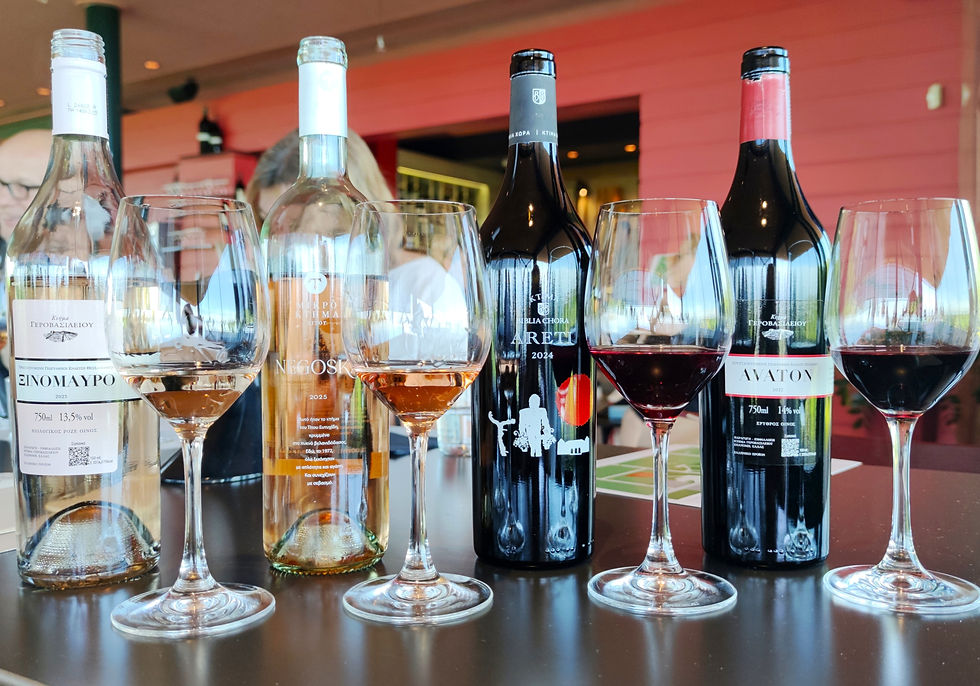
FLIGHT THREE
1. Ktima Gerovassiliou Xinomavro 2025
2. Mikro Ktima Titos Negoska 2025
3. Ktima Biblia Chora Areti Red 2024
4. Ktima Gerovassiliou Avaton 2022
Kostas choice of indigenous red varieties comprised Xinomavro, Negoska, Agiorgitiko and a blend of Limnio, Mavroudi and Mavrotragano.

Mikro Ktima Titos is a small estate situated near Goumenissa in Central Macedonia - North-West of Thessaloniki (PGI Paiko). Originally planted in 1972, the winery`s current focus lies on two varieties: Xinomavro and Negoska. At an altitude of around 280 metres, the climate here is continental with cool winters and mild summers. At the foot of the Paiko mountain range the surrounding oak forests provide protection against cold dry winds. Of the four wines presented, I had two preferences although I enjoyed all four - with freshness throughout.
▫ Mikro Ktima Titos Negoska – Negoska produces rich, fruit-powered wines with softer tannins than Xinomavro. A late harvest in October was followed by gentle pressing. A palatable dry rosé - beautifully pale salmon pink in colour with ripe strawberry and tart grapefruit on the nose. Vinified in stainless steel, a few months on the lees lend body and structure. The acidity is salty, increasing the already long, sour-cherry finish.

▫ Ktima Gerovassiliou Avaton 2022 – an ideal summer red cuvée uniting three regions with three indigenous varieties: originally from the island of Limnos, Limnio is believed to be one of Greece`s oldest native varietals. Its’ attributes include ripe dark fruit and mediterranean herbs and spice.
Mavroudi – popular in North-East Greece – brings depth of colour and structure and Mavrotragano – native to Santorini – delivers vibrant acidity and robust tannins.
A winning combination and wonderfully deep ruby red, with ripe black fruit on both nose and palate. Alcoholic and malolactic fermentation in stainless steel, then aged for approximately one year in 500 litre French Oak barrels. Following a further year in the bottle, the tannins are smooth with notes of blackcurrant, plum and black cherry. Dried fruit, cocoa and coffee complete the long spicy finish and full body.
Ready to enjoy now but also a great candidate for your cellar.
▪ INTERNATIONAL REDS
FLIGHT FOUR
1. Ktima Gerovassiliou Syrah
2. Ktima Biblia Chora Ovilos Red
3. Ktima Dio Ipsi Trilogia
The last of the five wineries -Ktima Dio Ipsi - belongs to the Ktima Biblia Chora Group. Nestled in the rolling hills of an enchanting valley located in western Peloponnese, the vineyard roots go back to 1990 and pharmacist Christos Kokkalis. His claim to fame: the internationally acclaimed Greek Cabernet Sauvignon - Trilogia, a legacy wine still produced today - albeit a limited Edition. With the mediterranean climate, this region is especially suitable for international varietals such as Syrah, Malbec and as is the case with Trilogia, Cabernet Sauvignon.

As I write (July 2026), Ktima Gerovassiliou`s team is busy reducing their Syrah yields. What looks like a terrible waste of grapes is in fact targeted selection with purpose: to intensify aromatics and achieve the best possible level of ripeness.
You should certainly save a premium spot in your cellar for Ktima Gerovassiliou Syrah 2024 - a beautiful Syrah which will only improve with age.
My personal preferences though, fell on Biblia Chora`s Ovilos red 2021 and Dio Ipsi`s Trilogia 2020.

▫ Ktima Biblia Chora Ovilos Red 2021 - PGI Pangeon. 100% Cabernet Sauvignon harvested from the estate`s oldest vineyards. A deep ruby to garnet red with an enticingly fruity nose, red and stewed fruit, black cherry and cassis.
The palate is full-bodied, high in acidity, the tannins well integrated. Lengthy maceration followed by 16 months in new French oak then a further 24 months in the bottle prior to release.
This is a mouthful of wine with exceptional ageing potential. Fruity without being jammy accompanird by underlying notes of cedar wood and tobacco.
Great with a meal or enjoyed on its own.
▫ Ktima Dio Ipsi Trilogia 2020 – a tenacious Cabernet Sauvignon and befitting of its’ namesake. Extended maceration, fermented in stainless steel then aged for 15 months in new French oak.
The nose is complex opening to a basket of raspberries and allspice on the palate. Tannins are firm, acidity high, the mouthfeel elegant with a long finish. Still a little unruly, Trilogia is the adolescent teenager of the three but with great potential. An absolute allrounder and fine-dining accompaniment - in spring, summer, autumn or winter!

AN EPANOMIAN SYMPOSIUM

A visit to the Gerovassiliou Estate can`t possibly be complete without an Epanomian Symposium.
In comparison to the Athenian Symposium, in Epanomi everyone`s welcome - even the girls - so the so-called café serves fine wines together with mouthwatering epicurean delights.
Unsurprisingly, Kostas still had two wines up his sleeve as a compliment our meal. The selection of mezedes brought to the table were outstanding and served together with Viognier – one with and one without Syrah:
Ktima Gerovassiliou Viognier 2024
Ktima Gerovassiliou Evangelo 2023.
The dishes - as I suggest you will see below - speak for themselves.


In Greece wine is considered a Gift of the Gods. To be enjoyed with all five senses and experienced from the heart.
In Greek Mythology, Dionysus was to blame for sharing winemaking with the mortals. According to Greek beliefs however - the consumption of undiluted wine causes blindness, insanity (mania) or worse.
Should this be true though, Greece would be riddled with four-eyed, delirious inhabitants - which I can assure you – is most definitely NOT the case!
My heartfelt thanks to the whole team at Ktima Gerovassiliou – least of all to Konstantinos (Kostas) Arvanitakis - for your generous hospitality and this truly memorable experience.

In July 2026
A trip to Northern Greece, kindly organised by Wines of Greece in collaboration with the Winemakers of North Greece wine hub.


Fotocredits: unless otherwise stated - Gail Treuer