The Art of Ouzomezedes
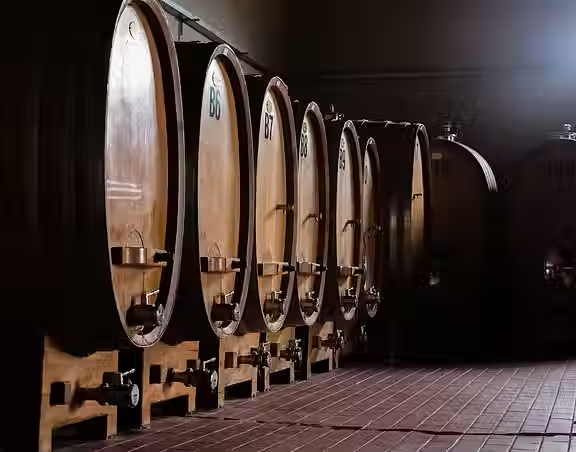
Katsaros Distillery & Winery, Thessaly

Many countries have a national beverage and Greece is no exception. Yet the Greek`s national tipple, like the ancient Greek Symposium, is somewhat of a ritual. The Art of Ouzomezedes is an informal social get together whereby food is less of an option than of a necessity.

An Ouzomezedes refers to the tradition of serving Mezedes – small dishes such as olives or feta cheese – seafood is also extremely popular - alongside Ouzo but most importantly, in good company or as the Greeks say, parea.
Produced using a neutral base-alcohol often sourced from grapes or grains, Ouzo`s hallmark is undoubtedly the strong anise flavour - although other ingredients such as fennel, cloves or coriander may also be included. It`s often served abroad as an aperitif but in the Greek homeland, Ouzo is enjoyed for the duration of the whole meal - served on ice or mixed with water. At around 37.5 to 40 percent alcohol by volume, Greece`s culture symbol is best not taken on an empty stomach.

OUZO TYRNAVOU
With their 160-year-old recipe and four generations of experience, the Katsaros family in Tyrnavos, Thessaly are considered the longest standing producers of Ouzo. Established in 1856, the Katsaros Distillery and Winery is now run by great grandson Nikolaos Katsaros, who took over the business at the age of thirty following his father`s death.

The company had been struggling, but together with Nikolaos` mother Katsarina, their determination has paid off. Not however, before Nikolaos (junior) had established the distillery`s heritage. A 1935 publication of the Thessalonian Chronicles supplied valuable historical evidence confirming the Katsaros family`s early involvement in the production of Ouzo. Compared with traditional Raki, Ouzo involves a more elaborate production process, sometimes including a second or even third distillation in the Amvikas - or copper vessel. What really sets Ouzo apart though, is its characteristic anise flavour.

In 1856, Nikolaos Katsaros (senior) acquired a traditional copper distilling cauldron from relatives, possibly a Raki still, as commonly used at the time. Drawing on the Tyrnavos’ established Raki-making tradition, he developed his own recipe using fourteen herbs and other botanicals and began experimenting with aromatic distillation. In doing so, he`d laid the cornerstone for the family distillery.

COPPER & CAULDRONS
At first glance, one might be forgiven for thinking the region of Thessaly is home to a real bunch of boozers, as Tyrnavos is not only one of Greece’s traditional centres of Ouzo production. Thessaly boasts a much older distilling tradition producing a spirit as popular with locals, as it is abroad. Tsipouro is distilled throughout Greece, but Tsipouro of Thessaly and Tsipouro of Tyrnavos are two of the better-known products with Protected Geographical Indication (PGI) status.

Tsipoura’s history dates to the 14th century and is a grape-based (grape-marc) spirit deeply rooted in the country’s winemaking heritage yet compared to Ouzo, Tsipouro is not necessarily enhanced with Anis or other botanicals. Having established vineyards at the foot of their monasteries on the towering Meteora rock-cliffs, the monks of Meteora learnt the art of distillation from their brothers of Mount Athos.
In addition, the Agrafa region in southwestern Thessaly was rich in copper deposits, so local coppersmiths became skilled in crafting the cauldrons necessary for distillation. Over time, the practice spread across northern Greece, with travelling coppersmiths and distillers carrying their knowledge further afield to Thessaloniki and Constantinople.

THE DOWRY`S HIGH SPIRITS
The Katsaros family produce both double- and triple-distilled spirits. Their Tsipouro is made from 100% locally grown Black Muscat of Tyrnavos (Moschato Mavro Tyrnavou) – an intensely aromatic variety strongly associated with Tyrnavos since its introduction to Thessaly in the 1930s.

The portfolio includes Angel Tears Tsipouro, introduced in 2018 and for which only the finest middle cut, known as the heart, is retained. Triple-distilled Angel Tears - awarded several gold medals at an international level - is anise-free and aged in stainless steel for at least six months.

Another Katsaros award-winner is their Aged Tsipouro Katsaros: toasted French oak in which the spirit matures for three years lends for a beautiful amber colour and far more complexity on both nose and palate.

Something I learnt during my visit: producing just fifty litres of Tsipouro requires approximately 1,500 kilograms of grape skins. That is one hell of a lot of marc for a mere sixty-seven bottles (0.75 litres each).
This explains perhaps, the size of the privately owned 6,000-square-metre site on which the modern distillery was established in 2007. According to Nikolaos, the fully automated bottling line can handle 2,000 bottles per hour.

Now for a little playful arithmetic: running at full capacity over an eight-hour shift, the production line could fill 16,000 bottles of Tsipouro. That would require a staggering 360 tonnes of grape skins. Phew! I suspect the bottling line spends more time waiting for the master distillers than the other way around.

Since 2017, Katsaros has also produced two ranges of wine; 4 Generations and ARIA whereby they use Greek and international varieties including Xinomavro, Assyrtiko, Limniona and Merlot. Considering 1,500 kilograms of whole grapes could theoretically yield around 1,333 bottles of wine rather than just sixty-seven bottles of Tsipouro, it is no wonder the family diversified into winemaking! (only joking ;-))

FROM ONE CUT TO THE NEXT
Despite the PGI status of Ouzo and Tsipouro of Tyrnavos, which of course offers reassurance concerning origin and production standards, there is another and rather peculiar way, of judging a spirit’s calibre.

When water is added to Ouzo or anise-flavoured Tsipouro as is customary, the clear spirit turns cloudy or opaque. This phenomenon is known as the Tyndall- or so-called Ouzo Effect. Water dilutes the alcohol level – hence lowers alcohol concentration. This causes the previously dissolved anise oils to form numerous tiny droplets, which in turn, scatter light. The beverage becomes cloudy and according to the expects, the cloudier the better – well, at least that`s the theory.

Another party taking a keen interest in proceedings is the beloved taxman, although he is less concerned with appearances. Before bottling may even take place, the authorities install an official seal on all storage tanks to ensure that every single millilitre is accounted for and subsequently duly taxed. So while the distillers chase perfection and the taxman counts every drop, one wonders whether his own glass is also subject to the exact same rigorous scrutiny ;-).
OUZOMEZEDES
This passionate form of Greek art, as demanding as it is provocative, celebrates conversation, good cuisine and the warmth of community and was something I had the pleasure of experiencing both during my visit to the Katsaros Distillary, as much as I did afterwards and in excellent company in the small town of Larisa.

Should you ever find yourself in Thessaly, I highly recommend a visit to both the Katsaros Distillery in Tyrnavos, as well as to Kymatoligi … Flavors of the Sea in Larisa in order to enjoy your very own Ouzomezedes, which, as you may have gathered by now, has absolutely nothing to do with the production of German cars! 😉

My heartfelt thanks go to Nikolaos Katsaros and Zoi Ntokou for their warm hospitality and for offering such a fascinating glimpse into one of Greece’s rich traditions and cultural heritage.
For more information, sales and enquiries please contact:
KATSAROS NIKOLAOS
Tyrnavos Distillery & Winery
7th km Tyrnavos
Larisa Rd
Tyrnavos
Thessaly
Greece
Tel: (+30) 2410 831420E-mail: info@ouzotirnavou.gr
In July 2026
A trip to Northern Greece, kindly organised by Wines of Greece in collaboration with the Winemakers of North Greece wine hub.